PathRoamer

Explore smarter travel guides, itineraries, and trip planning tools.
thailand festivals

Thailand Festivals Guide

Thailand is one of Asia's most festival-rich destinations, and that is not a claim made lightly. Every month of the year holds at least one significant celebration somewhere across the country. Some are deeply spiritual occasions rooted in centuries of Buddhist tradition. Others are large street celebrations that draw visitors from every corner of the world. Many are both at the same time, layered with meaning and alive with color, sound, and food.

Festivals in Thailand are not performances staged for tourists. They are genuine expressions of community, faith, and cultural identity, and travelers who plan trips around them consistently describe those experiences as among the most memorable of their lives.

This guide covers the most important festivals in Thailand, what each one means, where to experience it best, and what travelers should know before they arrive. Whether you are planning your first visit or returning to go deeper into Thai culture, understanding the festival calendar will transform how you experience this country.

Why Festivals Are Important in Thailand

The Role of Buddhism in Thai Festivals

Buddhism is not simply a religion in Thailand. It is the cultural framework through which most Thai people understand time, community, morality, and the rhythm of the year. Roughly 95 percent of the Thai population identifies as Buddhist, and that shared spiritual foundation shapes the national calendar in ways that are visible everywhere.

Most major Thai festivals have Buddhist origins or deep Buddhist dimensions. Songkran, the Thai New Year, involves temple visits and merit-making. Loy Krathong is an act of gratitude and release with strong spiritual symbolism. Even festivals that have evolved into large public celebrations retain their ceremonial core. The monks, the temples, the rituals of offering and prayer: these are not decorative. They are the reason the celebration exists.

Community and Family Traditions

Thai festivals are fundamentally communal events. They are times when extended families reunite, when neighborhoods cook and celebrate together, and when communities reaffirm bonds that hold through the rest of the year. Songkran sees millions of Thais travel home to be with their families. Loy Krathong fills riverbanks with couples, parents, children, and grandparents standing side by side in the dark.

For visitors, this communal character is part of what makes Thai festivals so moving.

How Festivals Shape Thai Culture

Thai culture is generous, joyful, and deeply hospitable, and festivals are where those qualities come into fullest expression. The social norms around festivals teach values: respect for elders, gratitude toward nature, the importance of making merit. Children grow up learning these values through participation, not instruction.

Festivals also mark agricultural and seasonal rhythms. The timing of Songkran aligns with the hottest and driest point of the year. Loy Krathong falls at the end of the rainy season when rivers run full. These connections to the natural world give Thai festivals a grounding that purely commercial celebrations tend to lack.

Why Festivals Create Unique Travel Experiences

A destination looks different during a festival. Cities that feel calm and navigable on ordinary days become electric. Streets close and fill with people. Temples overflow. Markets expand. Food vendors appear on every corner.

More than the spectacle, festivals offer travelers a window into daily Thai life that ordinary sightseeing rarely provides. You see how people treat each other, what they value, what makes them laugh. You participate rather than observe.

Cultural Etiquette During Festivals

Attending Thai festivals respectfully requires some preparation. Temple visits demand modest dress: shoulders and knees covered, shoes removed before entering. During water festivals, it is generally accepted that you will get wet in public spaces, but dousing monks, elderly people, or people who have not entered the main celebration areas is inappropriate.

Photography is welcomed at most festivals, but photographing religious ceremonies requires sensitivity. If people are praying, lower your camera and give them space. Always ask before photographing individuals up close. Offer a smile and a polite gesture rather than thrusting a lens forward.

Participating in local customs, even imperfectly, is almost always welcomed. Thais are generous toward visitors who show genuine interest and respect.

Songkran Festival

Songkran Festival Thailand

What Is Songkran?

Songkran is the Thai New Year, celebrated annually from April 13 to 15. It is the most widely observed festival in the country and one of the most spectacular in all of Asia. The name comes from a Sanskrit word meaning the movement of the sun into a new zodiac sign, and the festival marks the start of the traditional Thai solar calendar.

Historical and Cultural Meaning

Songkran has been observed in Thailand for centuries. In its original form, it was a time for spiritual purification, family reunion, and the paying of respect to elders. Water played a central role because water carries symbolic power in Buddhist tradition: it cleanses, it blesses, it renews.

The ritual pouring of water over Buddha images in temples and over the hands of respected elders remains the heart of the festival. These gestures are not just courtesies. They carry genuine spiritual weight.

Traditional Songkran Activities

Temple Visits

Songkran morning begins at the temple for most Thai families. People bring offerings, pray, and participate in the ceremonial bathing of Buddha images with scented water. These visits are peaceful, fragrant, and deeply moving.

Family Gatherings

The days of Songkran are among the most important family reunion occasions in the Thai calendar. Adult children return to their parents' homes. Extended families gather for meals. Younger members perform the rod nam dam hua ceremony, gently pouring water over the hands of their elders as a gesture of respect and a request for blessings.

Water Blessing Rituals

Throughout the festival, water is used ritually as a form of blessing. What began as a gentle sprinkling evolved over generations into something more exuberant, and today the public water fights that characterize Songkran in tourist areas represent an expression of that same energy, just louder and considerably wetter.

Modern Water Celebrations

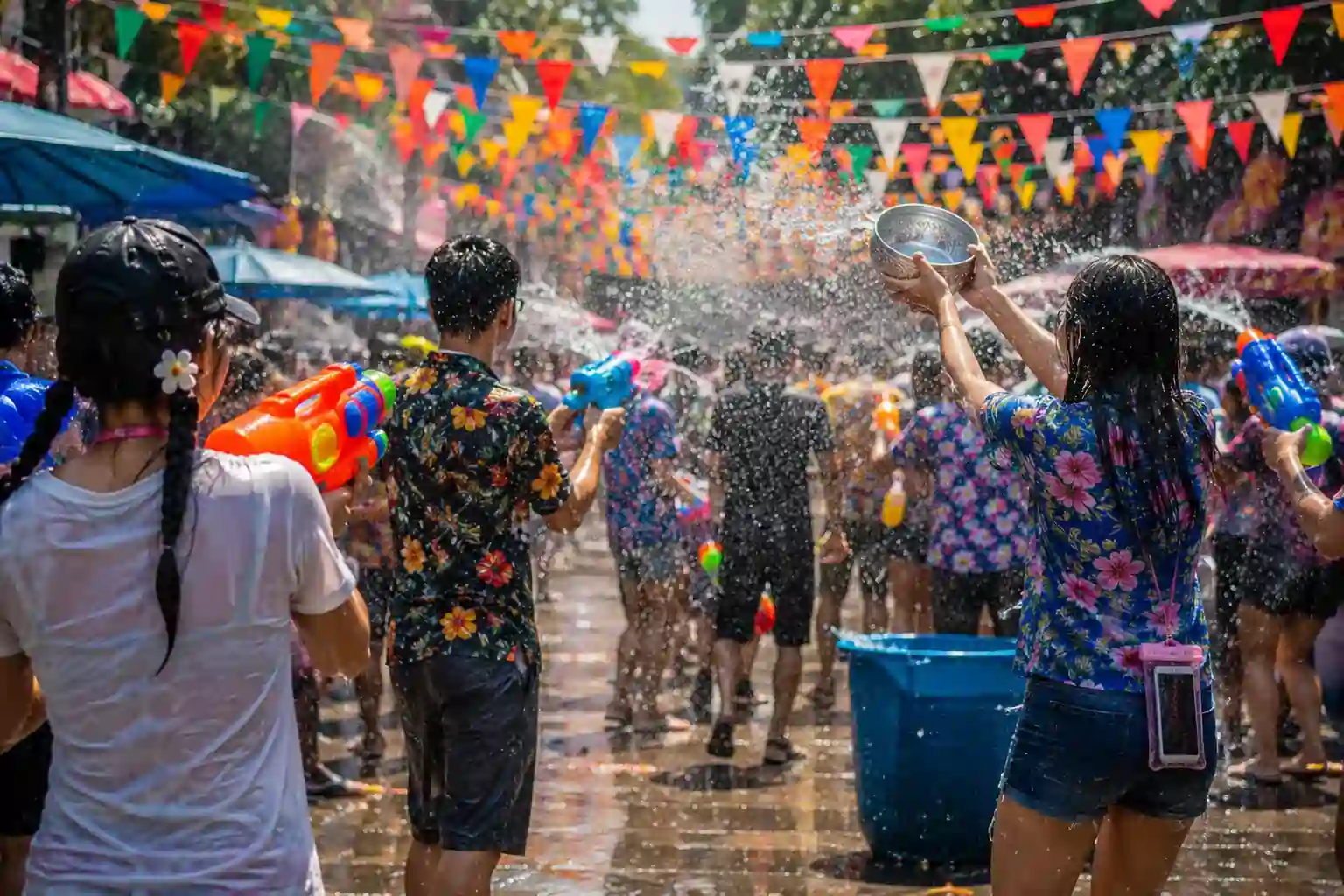
In Bangkok, Chiang Mai, and other major cities, Songkran has become a full-scale water festival. Streets are closed to traffic and converted into arenas for good-natured water battles. Water guns, buckets, and hoses are deployed with enthusiasm. The mood is infectious and almost universally joyful.

Best Places to Experience Songkran

Bangkok

Bangkok's Silom Road becomes one of the most famous Songkran celebration zones in the country. Thousands gather for days of water fights, live music, and street food. The city's temples also hold significant traditional ceremonies that offer a quieter, more spiritual side of the festival.

Chiang Mai

Many travelers consider Chiang Mai the best place to experience Songkran in all of Thailand. The old city moat becomes a natural water feature for the celebrations, and the combination of magnificent temples, a compact walkable center, and passionate local participation creates an atmosphere unlike anywhere else in the country. See our Chiang Mai Travel Guide for where to stay and how to get around during the festival.

Phuket

Phuket's Songkran celebrations are large and lively, with significant activity around Patong Beach and in Phuket Town. The island's mix of Thai and Chinese cultural traditions gives the celebrations a distinctive character. Our Phuket Travel Guide covers the island's neighborhoods and how to navigate them during peak season.

What Travelers Should Expect

Expect to get thoroughly wet if you spend any time in public celebration areas. Expect roads to be busy, guesthouses to fill up, and prices to rise. Expect temples to be more crowded than usual in the mornings and streets to be more crowded in the afternoons. Expect noise, warmth, and an atmosphere of genuine celebration.

Tips for Visiting During Songkran

Book accommodation at least two to three months in advance, particularly in Chiang Mai. Pack waterproof bags for phones and cameras. Wear lightweight clothes you do not mind soaking. Avoid traveling by road between cities during April 13 to 15 if possible, as traffic is exceptionally heavy. Keep valuables secured. Join the celebrations with openness and good humor.

Loy Krathong Festival

Loy Krathong Festival Thailand

What Is Loy Krathong?

Loy Krathong is one of Thailand's most visually beautiful festivals, held on the evening of the full moon in the twelfth month of the Thai lunar calendar, which falls in November. "Loy" means to float, and "Krathong" refers to a small decorated vessel traditionally made from banana leaves, flowers, candles, and incense sticks.

Meaning Behind the Festival

The act of floating a Krathong carries multiple layers of meaning. Most Thais describe it as a way of offering thanks to the goddess of water, Mae Khongkha, who sustains life throughout the year. It is also a moment of personal release: letting the Krathong carry away bad luck, grievances, and the troubles of the past year.

For many people, especially couples, Loy Krathong is a deeply personal and romantic occasion. The setting, riverside or lakeside, full moon overhead, thousands of candle-lit boats drifting on dark water, creates an atmosphere unlike anything else.

Floating Krathong Tradition

Krathongs are crafted by hand, traditionally from a cross-section of banana trunk decorated with folded banana leaves, flowers, incense, and a candle. Modern versions sometimes use bread (which fish can eat) or other biodegradable materials. You place the Krathong in the water, light the candle and incense, make a wish, and release it. Watching it drift away with the current is a strangely moving experience even for visitors unfamiliar with the spiritual context.

Best Places to Experience Loy Krathong

Bangkok

Bangkok holds large Loy Krathong celebrations at parks, riverside venues, and public spaces throughout the city. Sanam Luang and the Chao Phraya riverbanks fill with people. The scale is impressive, though the sheer size of the city means the mood is more diffuse than in smaller locations.

Sukhothai

Sukhothai is widely considered the most atmospheric place in all of Thailand to experience Loy Krathong. The historical park, home to ancient temple ruins illuminated at night, hosts a week-long festival with candlelit processions, traditional dance performances, and the floating of Krathongs in the reflecting pools around the ancient monuments. If you visit only one place for Loy Krathong in your lifetime, make it Sukhothai.

Chiang Mai

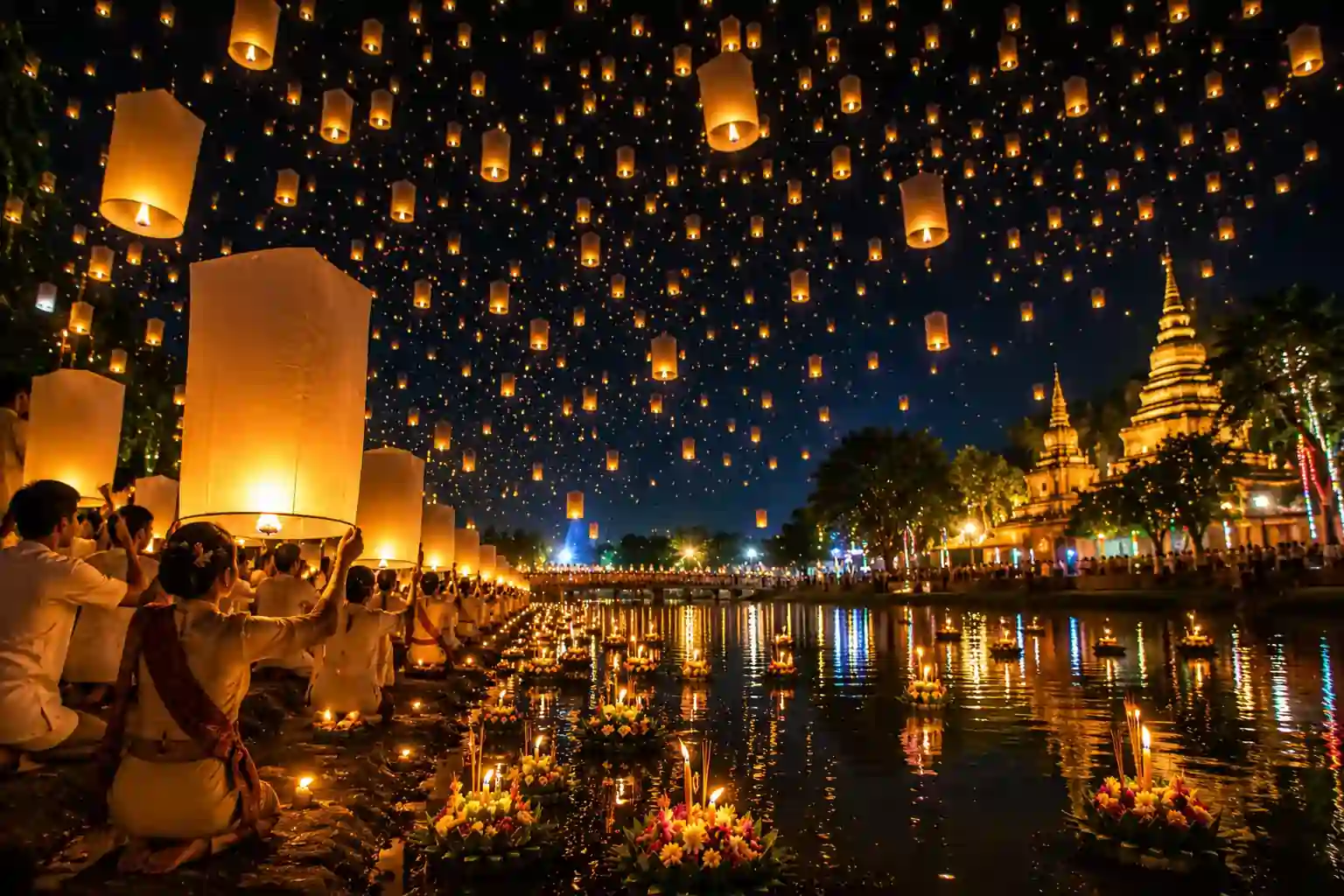
Chiang Mai combines Loy Krathong with Yi Peng, the northern lantern festival, creating a double celebration of extraordinary beauty. The Ping River fills with floating Krathongs while the night sky above fills with glowing paper lanterns.

Photography Opportunities

Loy Krathong is one of the most photogenic events in Southeast Asia. The combination of candlelight, flower petals, dark water, and the faces of people caught in a moment of genuine feeling creates images of remarkable beauty. Wide-angle shots of lantern-covered rivers and close-up portraits of people releasing their Krathongs are both rewarding.

Common Tourist Mistakes

Buying cheaply made plastic or foam Krathongs contributes to water pollution. Seek out biodegradable versions made by local craftspeople. Arriving at the riverside too close to the peak hour means fighting through very large crowds. Going slightly earlier and staying later than the busiest window gives you a more peaceful experience.

Yi Peng Lantern Festival
Yi Peng Lantern Festival Thailand

What Makes Yi Peng Different From Loy Krathong?

Yi Peng and Loy Krathong fall on the same night in Chiang Mai, and many travelers confuse them. Loy Krathong is a national celebration involving floating vessels on water. Yi Peng is a northern Thai tradition specific to the Lanna cultural region, and it involves the release of Khom Loi: large paper lanterns that float upward into the sky on warm air.

The two festivals complement each other perfectly. One sends light downward onto water; the other sends light upward into the sky.

Lantern Release Tradition

A Khom Loi lantern is made from rice paper stretched over a bamboo frame, with a fuel cell at the base. When lit, the warm air inside the lantern lifts it gently upward. Watching a single lantern rise is lovely. Watching tens of thousands rise simultaneously over a dark city surrounded by mountains is an experience people struggle to describe.

The release of lanterns is also a spiritual act. Sending a lantern skyward symbolizes the release of misfortune and the sending of prayers and wishes upward.

Why Chiang Mai Is the Center of Yi Peng

Yi Peng is rooted in the Lanna cultural tradition that defines northern Thailand. Chiang Mai, as the historic capital of the Lanna Kingdom, is the spiritual and cultural center of this tradition. The festival here involves multiple nights of events, including processions, temple ceremonies, and the mass lantern releases that have become famous worldwide.

Public vs Ticketed Events

Yi Peng in Chiang Mai has two distinct tiers. The public celebrations in parks, along the river, and in temple grounds are free and accessible to everyone. They are beautiful and well worth attending. Separately, a privately organized mass lantern release event sells tickets and provides a more controlled, photogenic setting. Both experiences have their advocates.

What Travelers Should Know Before Attending

Book accommodation in Chiang Mai many months in advance. November in Chiang Mai is peak season, and Yi Peng draws enormous numbers of visitors. Be aware of the smoke issue: the simultaneous release of thousands of lanterns creates haze that can affect air quality and visibility in photographs. Take fire safety seriously with your lantern. And remember that the spiritual meaning of the event deserves your respect even amid the spectacle.

Phuket Vegetarian Festival
Phuket Vegetarian Festival Thailand

Origins of the Festival

The Phuket Vegetarian Festival, known in Thai as Tesagan Gin Je, takes place over nine days in October during the ninth lunar month. Its origins trace back to the early nineteenth century, when a traveling Chinese opera company fell ill in Phuket. The company reportedly recovered after adopting a strict vegetarian diet and performing purification rites to honor the Nine Emperor Gods of Taoism. The festival has been observed in Phuket ever since.

Religious Significance

The festival is fundamentally a Taoist religious event, observed primarily by Phuket's Thai-Chinese community. The nine days represent a period of spiritual purification through vegetarian diet, prayer, and ritual. Devotees abstain from meat, alcohol, and various stimulating foods. The aim is to cleanse the body and mind and to invite the blessings of the Nine Emperor Gods.

Processions and Ceremonies

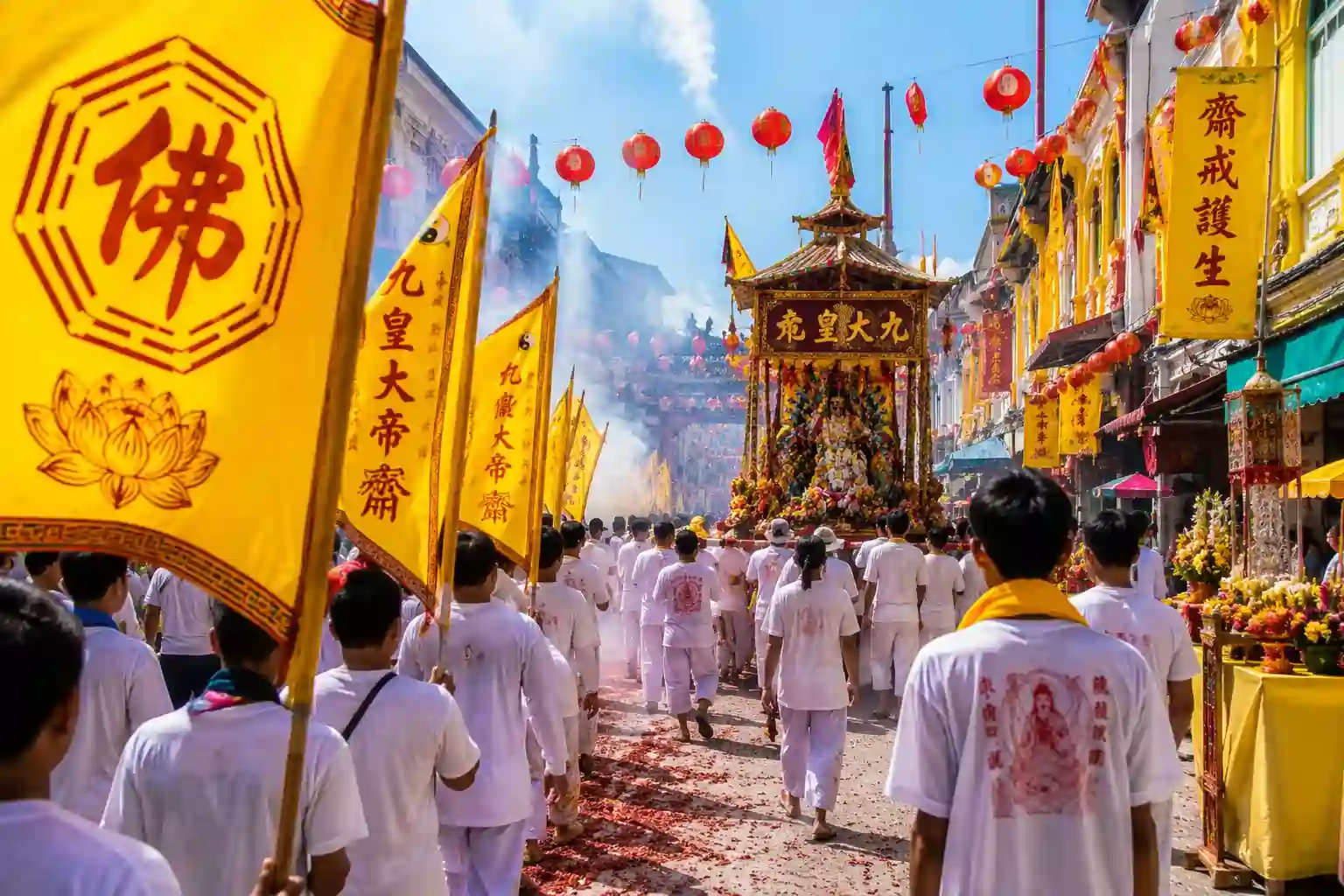
The Vegetarian Festival is internationally known for its ritual street processions, during which devoted participants called Ma Song enter trance states and perform acts of extreme body piercing: skewering their cheeks, tongues, and other body parts with swords, poles, and elaborate implements. These acts are understood within the tradition as demonstrations of divine protection and invulnerability.

The processions move through Phuket's streets with firecracker explosions, drumbeats, and incense smoke. Chinese shrines throughout the island serve as focal points for ceremonies throughout the nine days.

Why It Is Unique in Thailand

No other festival in Thailand combines religious devotion with this level of intense ritual performance. The Phuket Vegetarian Festival sits at the intersection of Taoist, Buddhist, and distinctly southern Thai Chinese cultural traditions. It is genuinely unlike anything else in the country.

What Visitors Should Expect

The street processions are open to the public and most visitors find them both thrilling and sobering. The scale of what some devotees undergo is confronting, but understanding the spiritual context changes how you experience it. Beyond the processions, the festival turns much of Phuket Town into a food paradise: stalls selling incredible vegetarian food line every street.

Cultural Respect and Photography Guidelines

Photography of the processions is generally acceptable, but treating the ceremonies as a curiosity show is not. Keep a respectful distance from Ma Song participants. Do not reach out to touch or interfere with participants. Follow the instructions of festival organizers, who often direct spectators for safety reasons during the processions.

Chinese New Year in Thailand

Chinese New Year in Thailand

Why It Is Celebrated Widely

Thailand has one of the largest overseas Chinese populations in Southeast Asia. Generations of Chinese immigrants settled across the country, particularly in Bangkok, Phuket, and Chiang Mai, and their cultural traditions became woven into the fabric of Thai life. Chinese New Year, which falls between late January and mid-February depending on the lunar calendar, is celebrated with genuine enthusiasm across the country.

Thailand's Chinese Communities

Bangkok's Yaowarat neighborhood, known as Chinatown, has been the heart of Thailand's Chinese community for more than two centuries. In Phuket, the Sino-Portuguese architecture of Phuket Old Town reflects the island's long history of Chinese settlement. In Chiang Mai, the Chinese community has deep roots going back to Yunnan Province traders who traveled south along ancient trade routes.

Best Places to Experience Chinese New Year

Bangkok Chinatown

Yaowarat transforms during Chinese New Year into one of the most spectacular street celebrations in Asia. The main road closes to traffic and fills with people, food vendors, lion dancers, fireworks, and lantern displays. The atmosphere is dense and alive.

Phuket Old Town

Phuket Old Town's celebrations have a distinctive character shaped by the island's Baba Nyonya cultural heritage. Street decorations are elaborate, family temple visits are central, and the food is exceptional.

Chiang Mai

Chiang Mai's Chinese New Year celebrations are quieter but charming, centered on the community's temples and markets.

Cultural Activities

Chinese New Year celebrations in Thailand feature lion and dragon dances performed by troupes who move through neighborhoods and enter businesses to bring good fortune. Temple visits involve offerings, incense, and the burning of paper money. Red envelopes containing money are exchanged between family members.

Food and Street Celebrations

Chinese New Year coincides with some of the finest street eating in Thailand. Yaowarat during the celebrations offers roast duck, dim sum, fresh seafood, and sweets that you cannot find at any other time of year. The combination of food, spectacle, and genuine community participation makes this one of the most rewarding urban festival experiences in the country.

Full Moon Party

Full Moon Party Koh Phangan Thailand

What Is the Full Moon Party?

The Full Moon Party is a monthly all-night beach event held on Haad Rin Beach on Koh Phangan. It draws between ten thousand and thirty thousand people depending on the time of year and has run in some form since the late 1980s. It is not a Thai cultural festival. It is a long-running international party that happens to take place on a Thai island, and that distinction matters when deciding whether to go.

How It Became Famous

What started as a small gathering of backpackers grew steadily through the 1990s into a fixture on the global travel circuit. Today it occupies a specific niche: it is famous enough that some travelers build entire itineraries around attending it, and experienced enough that it operates with a kind of predictable reliability that spontaneous beach parties never could.

What Travelers Can Expect

The night starts slowly and builds. By ten or eleven the beach is packed, the music is loud from several directions at once, and the neon body paint has taken over. Fire spinners work the crowd. Strangers share buckets of mixed spirits. By midnight Haad Rin feels less like a beach and more like an outdoor festival floor that happens to have sand underfoot and the Gulf of Thailand at its edge.

Around three or four in the morning the energy starts to release. People drift off in groups, some back to guesthouses, some to carry on elsewhere on the island. By sunrise the beach is quiet, dotted with those who stayed all the way through. Whether that sounds appealing or exhausting will tell you most of what you need to know about whether this is the right night for you.

Who Should Go

Travelers who are likely to enjoy it are those who want a large, high-energy beach party, are comfortable in dense international crowds, are traveling with friends, and are not particularly interested in Thailand as a cultural destination during that stretch of their trip. Backpackers on long Southeast Asia routes often find it a natural social occasion where meeting other travelers is easy.

Who Should Skip It

Solo travelers who find large drunk crowds stressful, anyone who came to Thailand primarily for temples, food, or nature, travelers who find large party environments exhausting rather than exhilarating, and anyone hoping for the kind of spontaneous, intimate beach experience that Koh Phangan's other coastline actually offers. The island away from Haad Rin is genuinely beautiful and far quieter. Most of that beauty is invisible on Full Moon Party night.

Safety Considerations

The Full Moon Party has a well-documented history of incidents: theft, spiked drinks, scooter accidents, and medical emergencies. Travel with friends, cover your drink, leave valuables locked at your guesthouse, and arrange your transport back before you need it. The local hospitals on Koh Phangan are experienced with Full Moon night. Going in prepared is not overcaution. It is just sense.

Alternatives for Travelers Seeking a Quieter Experience

Half Moon and Black Moon parties operate on a smaller scale for those who want a similar format with fewer people. For a completely different atmosphere, spending a full moon night at a Thai temple anywhere in the country is an experience that is quiet, beautiful, and entirely free.

See our Koh Phangan Travel Guide for more on what the island offers beyond the party circuit.

Best Festivals by Month

January

January is a quieter month on the festival calendar. The Full Moon Party runs as always on Koh Phangan. Some smaller regional temple fairs and local markets take place across the country, making it a good month to stumble across community celebrations that do not appear in any guide.

February

Chinese New Year typically falls in late January or February. Bangkok's Chinatown celebrations are at their peak. The Flower Festival in Chiang Mai takes place in early February, filling the city with floral floats and displays.

March

March is a transitional month for the festival calendar. Some regional temple fairs and local ceremonial events take place, and the country settles into a pre-Songkran calm. It is a good window to visit temples without the concentrated crowds that April brings.

April

Songkran dominates. April 13 to 15 is the official festival period, though celebrations in some cities extend for a week or more. This is one of the busiest travel periods of the year in Thailand.

May

Visakha Bucha, one of the most important days in the Buddhist calendar, typically falls in May. It marks the birth, enlightenment, and passing of the Buddha. Temple ceremonies take place across the country and the atmosphere at major temples is serene and spiritually significant.

June

Phi Ta Khon, the Ghost Festival of Dan Sai in Loei Province, typically falls in late June (the exact dates are set annually by local spirit mediums, usually on the first weekend after the sixth full moon). It is one of the most distinctive and undervisited festivals in Thailand: a three-day parade of residents wearing elaborate ghost masks and costumes, rooted in Buddhist legend. Worth planning around if you are traveling in the northeast.

July

Asanha Bucha and the beginning of Buddhist Lent (Khao Phansa) fall in July. The Candle Festival in Ubon Ratchathani is one of the most spectacular and undervisited festivals in Thailand, featuring enormous carved wax sculptures paraded through the city.

August

The Queen Mother's Birthday, a national holiday, falls in August and is observed with ceremonies in Bangkok and across the country. The Hua Hin International Jazz Festival is worth watching for, though its dates shift considerably from year to year (recent editions have fallen in May, August, and December). Check the Tourism Authority of Thailand for the current year's dates before planning around it.

September

The Moon Festival (Mid-Autumn Festival) may fall in September, observed with lantern displays, mooncakes, and family gatherings by Thai-Chinese communities across the country. Smaller temple fairs continue in the lead-up to the busier October and November season.

October

The Phuket Vegetarian Festival is October's defining event. The nine-day festival draws visitors from across Asia. The End of Buddhist Lent (Ok Phansa) also falls in October, bringing boat racing festivals to rivers across the country.

November

Loy Krathong and Yi Peng both fall in November, making it the single most visually spectacular month in the Thai festival calendar. Sukhothai, Chiang Mai, and Bangkok all hold major celebrations.

December

His Majesty the King's Birthday (National Day) falls on December 5 and is observed with formal ceremonies and illuminations at Sanam Luang in Bangkok. New Year celebrations on December 31 take place at major countdown events in Bangkok, Chiang Mai, and tourist islands across the country.

Festival Calendar Table

Festival Typical Month Main Location Suitable For
Chinese New Year January / February Bangkok, Phuket Culture, food, families
Chiang Mai Flower Festival February Chiang Mai Photography, nature lovers
Songkran April Nationwide Everyone, especially first-timers
Visakha Bucha May Nationwide Spiritual travelers
Phi Ta Khon (Ghost Festival) Late June Dan Sai, Loei Province Off-the-beaten-path travelers
Ubon Candle Festival July Ubon Ratchathani Spiritual travelers, culture seekers
Phuket Vegetarian Festival October Phuket Culture, food, photography
Loy Krathong November Nationwide Couples, culture, photography
Yi Peng November Chiang Mai Photography, spiritual travelers
Full Moon Party Monthly Koh Phangan Party travelers

Travel Tips for Festival Season

Booking Accommodation Early

Thai festivals attract enormous numbers of both domestic and international visitors. During Songkran in Chiang Mai, during Yi Peng weekend, and during the Phuket Vegetarian Festival, accommodation in the primary celebration city fills up months in advance. Book three to six months ahead for the most popular events. Waiting until a few weeks before will mean either no availability or very high prices.

Managing Crowds

The largest festivals bring genuinely large crowds. Streets that are normally easy to walk become slow-moving rivers of people. Managing crowds means arriving early, identifying less congested viewing spots in advance, accepting that some moments will be less intimate than you imagined, and building flexibility into your itinerary so that unexpected delays do not ruin the day.

Transportation Challenges

Domestic flights around major festival dates book up quickly and prices spike significantly. Trains and long-distance buses are also heavily used. If you are traveling between cities during Songkran especially, plan well in advance. Local transportation within festival cities is also disrupted: road closures, increased foot traffic, and higher-than-usual demand for taxis and tuk-tuks are all factors.

Weather Considerations

Songkran falls during Thailand's hottest months, with temperatures often exceeding 40 degrees Celsius in some parts of the country. Water fights are not just fun during Songkran: they are genuinely refreshing. Stay hydrated, use sunscreen, and take breaks indoors during the hottest hours of the afternoon.

Loy Krathong and Yi Peng fall in November, which is generally cool and pleasant in northern Thailand. Rain is possible in the south.

Respecting Local Customs

Every major Thai festival has a sacred dimension that deserves respect. Dress modestly when visiting temples. Follow local instructions regarding where spectators should stand during ceremonies. Avoid interfering with religious rituals for the sake of a photograph. Participating thoughtfully enriches your experience; treating ceremonies as entertainment impoverishes everyone present.

Photography Etiquette

Ask before photographing individuals at close range. Be especially discreet during religious ceremonies and private family moments. During the Phuket Vegetarian Festival processions, maintain a respectful distance from Ma Song participants. At Yi Peng, consider spending some of the lantern release simply watching rather than photographing. The experience of being present is different from the experience of documenting it.

Budgeting During Festivals

Prices for accommodation, food, and services rise during major festivals. Budget an additional twenty to thirty percent for festival periods and make peace with the fact that you are paying more to be part of something exceptional. Street food prices tend to remain reasonable, but guesthouses and hotels operate with premium pricing during peak festival dates.

For advice on timing and value, see our Best Time to Visit Thailand guide.

Which Festival Should You Experience?

Best Festival for First-Time Visitors: Songkran

Songkran is the right choice for most first-time visitors because it is accessible, joyful, and requires no special preparation beyond being willing to get wet. The combination of traditional temple ceremonies in the morning and water celebrations in the afternoon gives you both the cultural depth and the spectacular fun of Thai festival life in a single experience. It also happens in April, which is a common window for international travel.

Best Festival for Culture: Loy Krathong

Loy Krathong rewards travelers who want to engage with something spiritually meaningful and visually beautiful without the high-energy intensity of Songkran. The act of floating a Krathong is simple and personal. The setting, riverside, full moon, candlelight, is naturally contemplative. Visiting Sukhothai for Loy Krathong adds the extraordinary bonus of experiencing one of Thailand's great historical sites at its most magical.

Best Festival for Photography: Yi Peng

Yi Peng in Chiang Mai produces images that are difficult to achieve anywhere else in the world. The mass release of paper lanterns against a dark sky is a photographer's dream. The combination of Yi Peng lanterns above and Loy Krathong Krathongs on the river below means the entire visual spectrum from ground to sky is alive with light.

Best Festival for Food and Traditions: Phuket Vegetarian Festival

The Phuket Vegetarian Festival is unmatched for the intensity of its cultural specificity. The combination of extraordinary vegetarian street food, elaborate ritual processions, and the deep roots of the Phuket Thai-Chinese community makes this one of the most rewarding cultural festivals in Asia. It is not the right choice for visitors who are easily disturbed by graphic content, but for those drawn to authentic religious traditions, it is unforgettable.

Best Festival for Nightlife: Full Moon Party

No other event in Thailand matches the Full Moon Party's reputation for large-scale international beach nightlife. If that is what you are looking for, Koh Phangan delivers it reliably every month.

Quick Comparison Table

Festival Atmosphere Best For Crowd Level
Songkran Energetic, joyful, wet First-timers, everyone Very high
Loy Krathong Romantic, serene, spiritual Culture seekers, couples High
Yi Peng Ethereal, magical, photogenic Photographers, dreamers Very high in Chiang Mai
Phuket Vegetarian Festival Intense, traditional, flavorful Culture and food lovers Moderate to high
Chinese New Year Lively, festive, urban Food lovers, city travelers High in Bangkok
Full Moon Party Loud, international, hedonistic Party travelers Very high

Frequently Asked Questions

What is the biggest festival in Thailand?

Songkran is the largest festival in Thailand by scale of participation. It is a national holiday observed across the entire country with millions of participants. In terms of international recognition, Songkran and Yi Peng are probably the two most famous Thai festivals globally.

When is Songkran celebrated?

Songkran is officially celebrated from April 13 to 15 each year. In practice, celebrations in major cities like Chiang Mai often extend for a full week around those dates. The date is fixed in the solar calendar and does not move from year to year.

What is the difference between Loy Krathong and Yi Peng?

Loy Krathong is a national Thai festival involving the floating of small decorated vessels on water. Yi Peng is a northern Thai Lanna tradition involving the release of paper lanterns into the sky. They fall on the same night in November and are celebrated simultaneously in Chiang Mai, which is why the two are often seen together and frequently confused.

Is the Full Moon Party worth attending?

That depends entirely on what you want from your trip. If you enjoy large international beach parties, it absolutely delivers. If you are looking for cultural depth, local authenticity, or quiet natural beauty, it is probably not the right choice for you.

Which Thai festival is best for first-time visitors?

Songkran is the most recommended festival for first-time visitors. It is accessible, universally joyful, offers both cultural and spectacular dimensions, and is held nationwide so you can experience it from almost any base in Thailand.

Do I need to book accommodation early during festivals?

Yes, especially for Songkran in Chiang Mai, Yi Peng weekend in Chiang Mai, and the Phuket Vegetarian Festival. Booking three to six months in advance is strongly recommended for these events. Leaving it until a few weeks before almost always results in either no availability or significantly inflated prices.

Which festival is best in Chiang Mai?

Yi Peng and Loy Krathong together in November are the defining festival experience of Chiang Mai. Songkran in April is also exceptional in Chiang Mai, widely regarded as the best Songkran celebration in the country.

Which festival is best in Phuket?

The Phuket Vegetarian Festival in October is the most distinctive and culturally significant festival specific to Phuket. Songkran and Chinese New Year are also celebrated well on the island.

Which month is best for festivals in Thailand?

November is generally considered the best month for festival-focused travel in Thailand. Loy Krathong takes place nationwide, while Yi Peng transforms Chiang Mai with thousands of lanterns released into the night sky. The weather is also pleasant across much of the country, making it easier to combine festivals with sightseeing. April is another excellent choice because of Songkran, Thailand's New Year celebration and largest nationwide festival. The best month ultimately depends on what type of experience you want: November for beauty and culture, April for energy and participation, or October for the unique traditions of the Phuket Vegetarian Festival.

Do festival dates in Thailand change every year?

Some festivals follow fixed dates, while others are based on the lunar calendar and shift slightly each year. Songkran always takes place from April 13 to 15, but events such as Loy Krathong, Yi Peng, and the Full Moon Party occur on different dates annually. Chinese New Year also changes each year because it follows the lunar calendar. If your trip revolves around a particular festival, it's a good idea to confirm the exact dates before booking flights and accommodation, especially for popular events that attract large crowds.

Are Thai festivals family-friendly?

Most Thai festivals are highly suitable for families. Songkran, Loy Krathong, Yi Peng, and Chinese New Year are all occasions where children are fully present and welcome. The Phuket Vegetarian Festival processions involve graphic ritual content that parents should preview before bringing young children. The Full Moon Party is not suitable for children or families.

What should I wear during Thai festivals?

During Songkran, wear light, quick-drying clothes and sandals. Keep valuables in a waterproof bag. For temple visits at any festival, bring a scarf or light cover to ensure shoulders and knees are covered. During the Phuket Vegetarian Festival, wearing white is traditional among participants but not required of visitors. For evening festivals like Loy Krathong and Yi Peng, comfortable warm layers are useful in northern Thailand.

Plan Your Thailand Trip

Festivals are one of the best reasons to visit Thailand, but a great trip involves more than timing. These guides will help you plan every aspect of your journey, from choosing the best destinations and travel seasons to creating the perfect itinerary.

Scroll to Top